Pages

Ads 468x60px

Saturday, 26 March 2016

Cameron Diaz tops malware bait list

Cameron Diaz is the most dangerous celebrity on the Web, antivirus company McAfee said Thursday.
Search strings using Diaz's name have a one-in-ten chance of coming up with a site infected with or spreading malware, said Dave Marcus, McAfee's director of security research and communication. Search for "Cameron Diaz and screensavers," and the risk doubles, Marcus added.
Efficiency - a busy man at his desk, surrounded by chaotic paperwork
Efficiency hacks for IT: 6 tips for getting things done
Modern tech leaders wear many hats -- too many, sometimes. Here are six expert tips from seasoned IT

As it has for the last three years, McAfee compiled search phrases that contained names of prominent celebrities, professional athletes, politicians and other newsmakers, then calculated the percentage of the resulting sites tagged as dangerous by the company's SiteAdvisor software.

SiteAdvisor is a free plug-in for Microsoft's Internet Explorer and Mozilla's Firefox that flags risky sites -- those serving up malware, adware, spyware and the like -- in a search result list.

Diaz replaced Jessica Biel, last year's top name bait. Biel fell two spots to third on McAfee's list this year.

Actress Julia Roberts placed second on the Most Dangerous list, while supermodel Gisele Buendchen took fourth. Brad Pitt, the highest ranking man on the list and one of only two on the top 10, held the fifth spot.

"It's a simple fact. The bad guys read the same news as the good guys," said Marcus as he explained why some celebrities ranked higher than others. He attributed Diaz's prominence to the fact that McAfee's list was composed around the time when she was in two currently-showing films, "Knight and Day" and "Shrek Forever After."

Attackers and scammers trade on the names of prominent people and topical events to dupe users into visiting malicious sites, to open malicious e-mails, and to click on malicious links embedded in Twitter messages, said Marcus.

"Dangerous searches relate to the news of the day," he said. "In 2008, politicians like President Obama and [former Governor] Sarah Palin were the most abused. We expect politicians to be abused in the future."

Obama was at No. 49 on McAfee's list this year, while Palin was right behind the president at No. 50.
Others on the dangerous list included tennis player Andy Roddick (No. 14), and singers Lady Gaga (No. 37) and teenager Justin Bieber (No. 46).

"We're not saying stay away from searching for celebrities like Cameron Diaz," said Marcus. "We're saying be aware of the broad use of their names, and know that criminals are looking for a way to social engineer you, and this is the type of attack they'll use."

McAfee released the fourth annual most-dangerous celebrity list Thursday just minutes before it announced Intel was buying the company for nearly $8 billion. Before the interview with Marcus, a McAfee spokeswoman made it clear he would not take any questions about the acquisition.

Gregg Keizer covers Microsoft, security issues, Apple, Web browsers and general technology breaking news for Computerworld. Follow Gregg on Twitter at @gkeizer, or subscribe to Gregg's RSS feed .

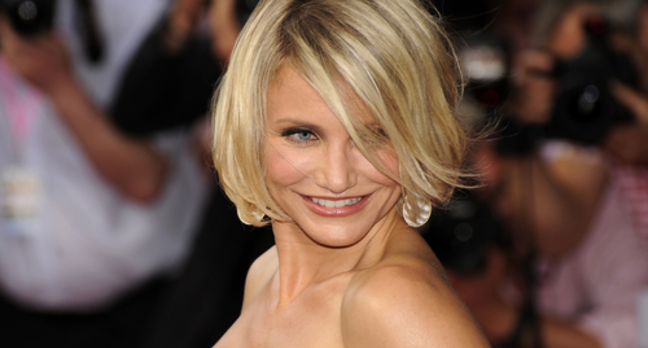
CAMERON DIAZ covers top BOFFINS in GOLD at Breakthrough Prizes

Benedict Cumberbatch, you really shouldn't have ...

Cameron Diaz
 
 
Cameron Diaz, Benedict Cumberbatch and Mark Zuckerberg were among the assembled luminaries at NASA's Ames campus in Silicon Valley over the weekend – where techbiz titans and people paid to pretend to be boffins in the movies distributed $36m at the Breakthrough Prize ceremony.

The money was awarded by tech luminaries on the Breakthrough Prize Board including Zuckerberg, Jack Ma and Sergey Brin.

Tech tycoons, boffins and celebs all rubbed shoulders at a lavish ceremony at NASA’s Hangar One on Sunday night, where the wealthy board led by Yuri Milner heaped millions on scientists for breakthroughs in life sciences, maths and fundamental physics.

The awards were handed out by the illustrious tech-heavy board along with celebs like Kate Beckinsale and Seth McFarlane.

"The world faces many fundamental challenges today, and there are many amazing scientists, researchers and engineers helping us solve them,” Mark Zuckerberg said in a canned statement.
“This year's Breakthrough Prize winners have made discoveries that will help cure disease and move the world forward. They deserve to be recognised as heroes."

The awards were started by Russian entrepreneur Yuri Milner, who made his fortune investing in firms like Facebook and Twitter and describes himself as a “failed physicist”. He reckoned that boffins were missing out on the big bucks for their research and managed to convince other techies with deep pockets to back a series of prizes for them.

Six different scientists were honoured for their work in Life Sciences, including Alim Louis Benabid for his high-frequency deep brain stimulation treatment for Parkinson’s disease and Victor Ambros and Gary Ruvkun for their work in genetic regulation by microRNAs.

Five mathematicians scooped the $3m prizes in the inaugural maths category for work in quantum field theories and analytics and other less-easily summarised fields.

Over 50 researchers are sharing the Fundamental Physics prize, led by Saul Perlmutter, Brian Schmidt and Adam Riess, who worked on the Supernova Cosmology project and the High-Z Supernova Search Team and discovered that the expansion of the Universe is accelerating, rather than slowing down, which had long been the theory.

The New Horizons in Physics prizes went to physicists working in quantum matter, high-intensity electron beams and quantum gravity. ®

The full list of prize winners are:

Breakthrough Prizes in Life Sciences

  • Alim-Louis Benabid, Joseph Fourier University, for the discovery and pioneering work on the development of high-frequency deep brain stimulation (DBS), which has revolutionized the treatment of Parkinson’s disease.

  • C. David Allis, The Rockefeller University, for the discovery of covalent modifications of histone proteins and their critical roles in the regulation of gene expression and chromatin organization, advancing the understanding of diseases ranging from birth defects to cancer.

  • Victor Ambros, University of Massachusetts Medical School, and Gary Ruvkun, Massachusetts General Hospital and Harvard Medical School, for the discovery of a new world of genetic regulation by microRNAs, a class of tiny RNA molecules that inhibit translation or destabilize complementary mRNA targets.

  • Jennifer Doudna, University of California, Berkeley, Howard Hughes Medical Institute and Lawrence Berkeley National Laboratory, and Emmanuelle Charpentier, Helmholtz Center for Infection Research and UmeĆ„ University, for harnessing an ancient mechanism of bacterial immunity into a powerful and general technology for editing genomes, with wide-ranging implications across biology and medicine.
 
Blogger Templates